
The Egg
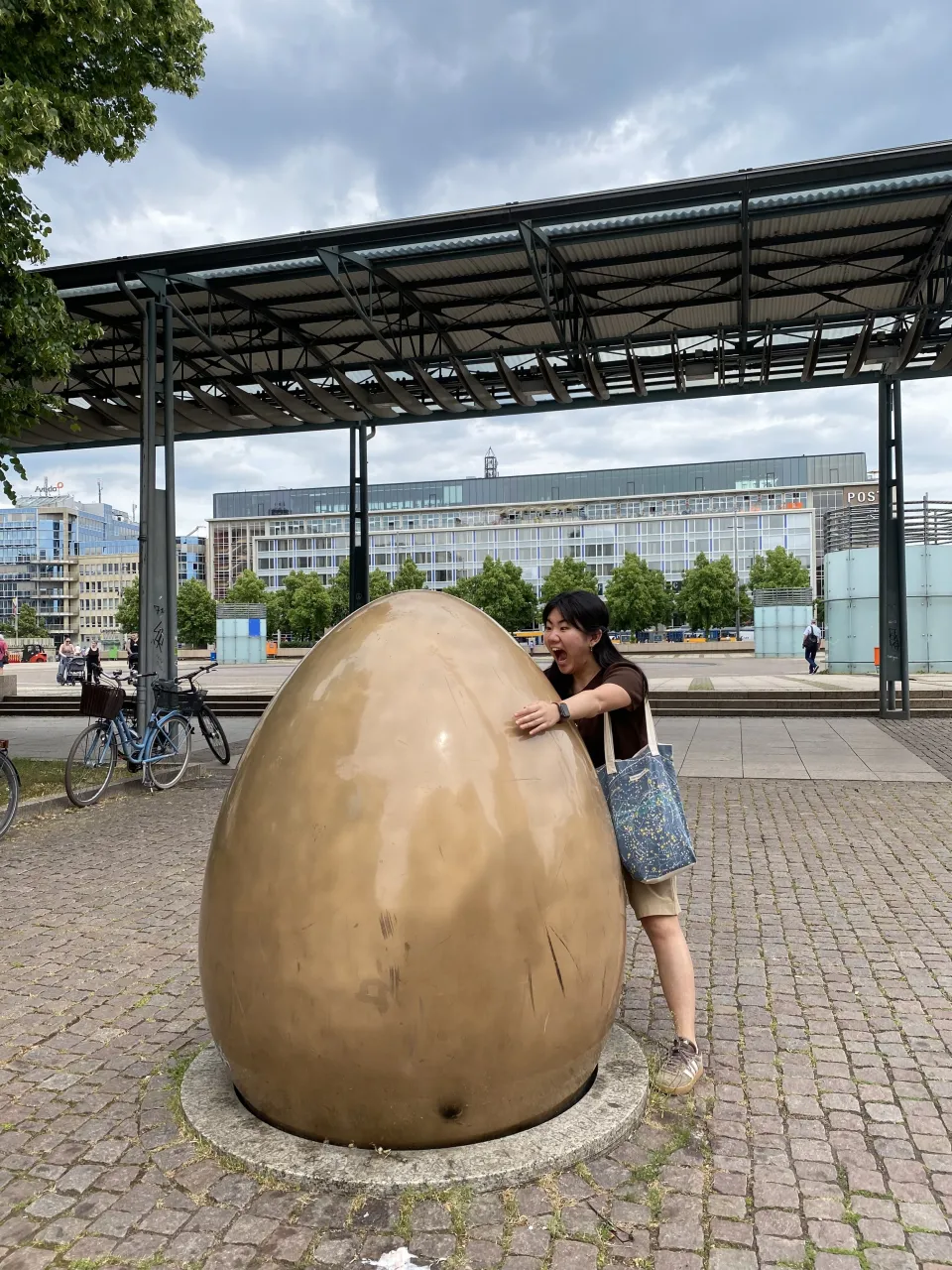
Now that we have spent a week together, everyone knows that ich liebe Eier! So no one would be surprised that my reaction upon spotting a giant egg across the street from Augustusplatz, was:
After a moment of fangirling and enthusiastic picture-taking, however, another thought occurred to me: Why is there an egg in the middle of the city?
According to my research, the egg has a name: Demokratieglocke, or The Democracy Bell. Standing only 10cm shorter than me at 150cm, it commemorates the Friedliche Revolution (“Peaceful Revolution”), a series of political protests in 1989 against the communist regime in East Germany, the GDR. These demonstrations ultimately contributed to the fall of the Berlin Wall and the reunification of Germany, and Leipzig played a particularly important role in the movement, serving as one of its major gathering places.
The monument, created by German artist Via Lewandowsky, is relatively new, unveiled on October 9, 2009 for the 20th anniversary of the Monday Demonstration of October 9, 1989.
If it’s a “bell,” does it ring?
Yes! It reliably chimes every Monday night at 6:35pm in remembrance of the beginning of the Monday Demonstration. On all other days, however, it sounds at random times for a random number of strikes within each hour between 8am and 8pm. In other words, don’t rely on the Demokratieglocke to tell the time.
When I first saw it, I was too preoccupied to notice words engraved in the granite ring around the egg. Apparently the inscription is a haiku by German lyric poet , essayist and translator Durs Grünbein:
“Demokratie ist – in unendlicher Nähe – längst sichtbar als Kunst”
(“Democracy is – in infinite proximity – long visible as art”)
But what does an egg have to do with democracy?
There seem to be several interpretations. An egg is often a symbol of new life and rebirth. Some point to the idiom sich ein Ei legen (“to lay an egg on oneself”), which colloquially means to create a problem for oneself that will eventually come back to haunt you. Others see the golden egg as a nod to the way many East Germans once viewed the West, as something golden and full of promise.
This blog is a public service announcement in favor of more peculiar artwork and monuments scattered throughout our cities. Not only do they add a sense of wonder to everyday commutes, but they also spark curiosity, which I believe is the best doorway to exploration and learning. Education and the preservation of history need not exist only in books or on Google; they can live in our physical environments as well. In an age of technology and constant stimulation, perhaps we need more reminders to look up, ask questions, and learn something new.
The next time I visit the egg, I will imagine myself standing amidst the Monday Demonstration: 70,000 people around me, candles in their hands and prayers on their lips, gathered peacefully in pursuit of freedom.
Sources: