🎥 New Youtube Video: Music at Princeton pt. 2!
Music at Princeton Pt.2: Study Abroad Edition is here!
I started this series in hopes of providing more insight into the wonderful music scene at at school for prospective students. Check it out on YouTube and share it with someone who might want to learn more about studying abroad!
If curious, the first video from two years ago provides a general overview of music buildings, ensembles, and classes.
Emerging Composers Intensive 🎵
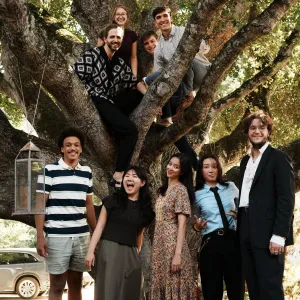
From June 26th–July 6th, I traveled to Hidden Valley in beautiful Carmel Valley, California, for what is aptly described as a "festival of collaboration." Each of the ten selected composers arrived with a newly written chamber work, which was rehearsed, refined, and developed throughout the week before receiving a wonderful premiere and professional recording at the festival's conclusion.
This summer’s composition faculty was incredible: Steven Mackey, Sarah Kirkland Snider, Amy Beth Kirsten, and Alistair Coleman. Each led seminars on their compositional process and offered invaluable career advice, in addition to one-on-one lessons where we revised our chamber works and discussed previous compositions. To spend each day surrounded by composers of this caliber—who were not only extraordinary artists but also unbelievably kind, generous, and supportive—and to be able to pick their brains about new musical ideas while learning from their experiences was an invaluable opportunity.
Unlike most festivals I have attended, the composers were also mentored by the incredible performers. At every rehearsal, they offered thoughtful and honest feedback on our writing for their instruments, introducing us to new technical possibilities while suggesting practical notation improvements. The collaborative process was refreshingly open and candid, pushing me to write music that is not only playable, but that truly captures the unique character of each instrument, allowing it to elevate my musical ideas to a new level of emotional depth.
Learn more about my piece, In This Short Life!
I was also inspired by the remarkable diversity of musical philosophies and compositional styles represented among the ten composers. It was wonderful to reunite with composer friends from previous festivals—Cashel, Alex, and Toussaint—while also forming new friendships with Catherine, Vivian, Mitchell, Ealaf, and Yangfan.
Young composers, you can have this experience too. Apply!
Ruminations from Leipzig 🇩🇪 2/2: "True joy is a serious matter."
Here is another one of my blogs from Leipzig!
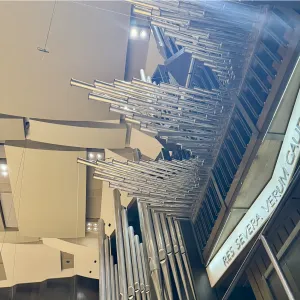
The mighty Gewandhaus in Agustusplatz, Leipzig-Mitte.
This was the first concert hall I had ever visited that proudly displayed text across its back wall. Even during performances, the inscription remains illuminated, looming over the stage as if constantly reminding the audience of its presence.
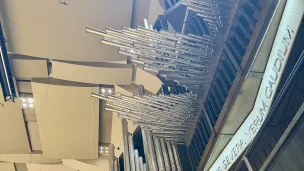
“Res severa verum gaudium.”
In Deutche: “Wahre Freude ist eine ernste Sache.”
In Englisch: “True joy is a serious matter.”
Upon my initial google search of the translation at the first Schiff concert, I immediately assumed it was a political statement in support of the arts. Perhaps the ongoing budget cuts to arts and culture were already on my mind.
As it turns out, this is the motto of the Gewandhaus Orchestra, appearing at the top of its mission statement. Directly beneath it, they write:
“Together we bring music to life in order to provide emotional sustenance for our audience. We demand of ourselves the highest possible quality of performance, the conscientious care of our tradition and unwavering commitment to the contemporary. We fulfil this credibly, seriously and enduringly.”
It reads as a promise from musician to listener: that the orchestra approaches its craft with the utmost seriousness and dedication.
The mission statement continues:
“The fostering of tradition and the instigation and cultivation of the new. The active striving for excellence. The creation of values. The nurturing of identity.”
So where do these words originate?
“Res severa verum gaudium” comes from the Stoic philosopher Seneca the Younger in his Epistulae Morales ad Lucilium (Moral Letters to Lucilius), a collection of 124 diary-like letters containing philosophical reflections addressed to Lucilius Junior, the procurator of Sicily during the reign of Nero.
The phrase appears in Letter 23, Section 4: “Verum gaudium res severa est.” The letter is titled On the True Joy Which Comes from Philosophy. Below is the original Latin, followed by the Wikisource translation.
Mihi crede, verum gaudium res severa est. An tu existimas quemquam soluto vultu et, ut isti delicati loquuntur, hilariculo mortem contemnere, paupertati domum aperire, voluptates tenere sub freno, meditari dolorum patientiam? Haec qui apud se versat in magno gaudio est, sed parum blando. In huius gaudii possessione esse te volo: numquam deficiet, cum semel unde petatur inveneris.
“Real joy, believe me, is a stern matter. Can one, do you think, despise death with a care-free countenance, or with a ‘blithe and gay’ expression, as our young dandies are accustomed to say? Or can one thus open his door to poverty, or hold the curb on his pleasures, or contemplate the endurance of pain? He who ponders these things in his heart is indeed full of joy; but it is not a cheerful joy. It is just this joy, however, of which I would have you become the owner; for it will never fail you when once you have found its source.”
In essence, Seneca reminds Lucilius that true happiness is not the same as constant cheerfulness. He challenges the hedonistic impulse to maximize pleasure and minimize pain, arguing instead that genuine joy comes from cultivating the inner strength to face hardship with courage, self-control, and resilience. Once you discover that source of joy within yourself, it cannot be taken away. Wealth or poverty, health or illness, praise or criticism—external circumstances may change, but they no longer determine your inner peace.
It is fascinating to see how words written sometime between AD 62 and 65 have traveled through nearly two millennia, acquiring new contexts and, with them, new layers of meaning. What began as Seneca’s meditation on the pursuit of inner virtue has become the guiding motto of one of the world’s great orchestras on profound artistic joy and the discipline it requires, eventually reaching my attention and sparking new dialogue.
Comment from a classmate, 16 July 2026:
Hi Yuri! Considering the fact that this is, as far as I understand, your personal motto as well, I wonder what you think it actually looks like for an an institution to commit to this purpose? More than a personal philosophy, how can joy be practiced at a wider scale, and what does that mean if we consider the origin of the sentiment. . . in the deeply personal, inward looking philosophy of Seneca?
My response, 17 July 2026:
Hi Julian! Thank you for your thoughtful comment; I love your questions! I believe that a non-negotiable ingredient of joy is a commitment to sharing it. We deprive joy of its full potential and meaning when we mistake it for a purely private experience. For an institution to truly commit to this purpose, I think it must offer more than serious dedication, artistic excellence, and thoughtful programming. It should actively invite its audience to celebrate being alive and getting to engage in the profound expression and human connection that art makes possible. (I’ve been thinking about this a lot lately—how performers can translate the joy of learning and performing a piece into an equally meaningful and rewarding experience for the listener. I’ve learned that a good starting point is simply embodying the joy of performing; our facial expressions and body language can go a long way toward inviting the audience into that experience.)
My belief may seem at odds with Senca’s intimate, inward-looking philosophy. But without first cultivating inner peace within yourself, it’s difficult to share it with others. And, when I read Seneca alongside Epictetus—“It is quite impossible to unite happiness with a yearning for what we don’t have”—I see a shared call to be fully present and content with the life before us. Marcus Aurelius takes that one step further when he writes that “joy for human beings lies in proper human work,” beginning with “acts of kindness to other human beings” and “contemplating the natural order and all that happens in keeping with it.” Something magical happens with joy at the point where inner revelation meets outward expression of generosity and community.
Ruminations from Leipzig 🇩🇪 1/2: The Egg
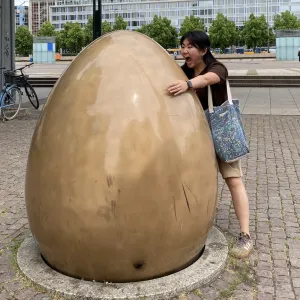
From June 1st-26th, I participated in Princeton’s study abroad program in Leipzig, Germany! It was a fulfilling month of attending daily German classes, music seminars, and Bachfest concerts, culminating in a beautiful final performance with my peers featuring music by Bach, Mendelssohn, the Schumanns, and others.
A part of the program required weekly blog posts on any topic of interest regarding Leipzig and our experiences there. I had a fun time working on them, so I thought I would share two of my reflections here.
The Egg
June 7, 2026
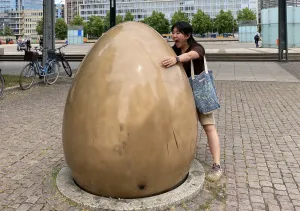
Now that we have spent a week together, everyone knows that ich liebe Eier! So no one would be surprised that my reaction upon spotting a giant egg across the street from Augustusplatz, was:
After a moment of fangirling and enthusiastic picture-taking, however, another thought occurred to me: Why is there an egg in the middle of the city?
According to my research, the egg has a name: Demokratieglocke, or The Democracy Bell. Standing only 10cm shorter than me at 150cm, it commemorates the Friedliche Revolution (“Peaceful Revolution”), a series of political protests in 1989 against the communist regime in East Germany, the GDR. These demonstrations ultimately contributed to the fall of the Berlin Wall and the reunification of Germany, and Leipzig played a particularly important role in the movement, serving as one of its major gathering places.
The monument, created by German artist Via Lewandowsky, is relatively new, unveiled on October 9, 2009 for the 20th anniversary of the Monday Demonstration of October 9, 1989.
If it’s a “bell,” does it ring?
Yes! It reliably chimes every Monday night at 6:35pm in remembrance of the beginning of the Monday Demonstration. On all other days, however, it sounds at random times for a random number of strikes within each hour between 8am and 8pm. In other words, don’t rely on the Demokratieglocke to tell the time.
When I first saw it, I was too preoccupied to notice words engraved in the granite ring around the egg. Apparently the inscription is a haiku by German lyric poet , essayist and translator Durs Grünbein:
“Demokratie ist – in unendlicher Nähe – längst sichtbar als Kunst”
(“Democracy is – in infinite proximity – long visible as art”)
But what does an egg have to do with democracy?
There seem to be several interpretations. An egg is often a symbol of new life and rebirth. Some point to the idiom sich ein Ei legen (“to lay an egg on oneself”), which colloquially means to create a problem for oneself that will eventually come back to haunt you. Others see the golden egg as a nod to the way many East Germans once viewed the West, as something golden and full of promise.
This blog is a public service announcement in favor of more peculiar artwork and monuments scattered throughout our cities. Not only do they add a sense of wonder to everyday commutes, but they also spark curiosity, which I believe is the best doorway to exploration and learning. Education and the preservation of history need not exist only in books or on Google; they can live in our physical environments as well. In an age of technology and constant stimulation, perhaps we need more reminders to look up, ask questions, and learn something new.
The next time I visit the egg, I will imagine myself standing amidst the Monday Demonstration: 70,000 people around me, candles in their hands and prayers on their lips, gathered peacefully in pursuit of freedom.
Sources:
Winner of New Voices Project for Composers Under 30
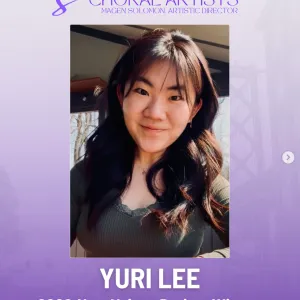
I am thrilled to share that I have been named this year’s winner of San Francisco Choral Artists’ New Voices Project for Composers Under 30! I’m deeply grateful and excited for the opportunity to have my choral work brought to life by SFCA this summer.
Although my classical training has focused primarily on composition and violin—with singing as a secondary but longstanding part of my musical life, shaped by seven years in the choirs of the Juilliard Preparatory Division—I discovered an unexpectedly profound connection to choral music at Princeton, where I’ve had the joy of performing with several vocal ensembles, including the Princeton University Glee Club, Chamber Choir, Vocal Consort, Decem, and the Princeton Footnotes. I am especially grateful to Gabriel Crouch and Mike McCormick for their inspiring direction and mentorship over the past three years, which have shaped my growth not only as a singer, but also as a choral composer.

Princeton Footnotes Winter Tour—HAWAII 🌸
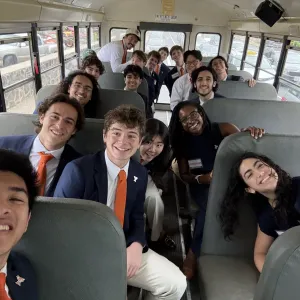
From Jan. 15th-23rd, the Princeton Footnotes went on our annual winter tour to Honolulu, Hawaii!
While I have attended several Footnotes tours before—the most recent being the NJ/NY tour over fall break, where we performed at retirement homes, high schools, a church, and the memorial of a Footnotes alum—this was the first time I was more involved in the behind-the-scenes work of curating a successful tour as the newly elected Music Director.
Throughout the week, we had several gigs: some in open-roof shopping mall centers, one in a middle school, one in a retirement home, as well as a workshop for high school students. It was a special experience to see sparkly-eyed children eager to pursue a cappella, as well as senior citizens smiling at us, seeing their grandchildren in us. I love how music instantly brings strangers across oceans together.
The main takeaway was the need to be ready to adjust plans as we went along. I learned the importance of flexibility in:
- adjusting the setlist of a performance if a soloist wakes up feeling under the weather;
- running rehearsals by taking note of which songs and sections needed polishing throughout the week;
- curating performances for different audiences—for young children, including more upbeat songs and making jokes during song introductions; and for senior citizens, speaking slowly and loudly and including more songs they may recognize; and
- planning performances of different lengths. For an hour-long set, I found it successful to add a few minutes of “talking filler,” during which one group member describes the ensemble, the collegiate a cappella tradition, and background information about our tour, allowing the rest of the group time to rest and drink water.
Side note: When in Hawaii, hike, go to the beach and catch the sunset, enjoy the sunset catamaran, and try the malasadas and Happy Musubi.
🎵 The Nebula Project, Volume 2: Helix
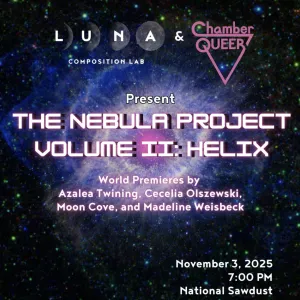
On Monday, Nov. 3rd, my piano trio Unlucky Little Lad was premiered by ChamberQueer in collaboration with Luna Lab! It was an incredible honor to hear the piece come to life at Brooklyn’s stunning National Sawdust, performed by such brilliant musicians. I’m deeply grateful for initiatives like this that create supportive, inclusive spaces for young artists to explore and share their voices.
Missy Mazzoli and Ellen Reid, founders of Luna Lab and two of the most incredible female composers of the generation were also there to celebrate the concert, and it is always a joy and inspiration to get to catch up with them.
🏆 The Princeton Shapiro Prize for Academic Excellence
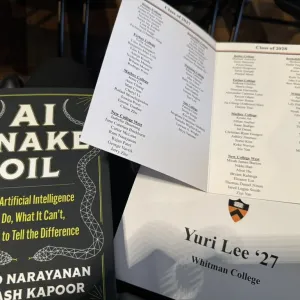
This fall, I am incredibly honored to have received the Shapiro Prize for Academic Excellence for 2024-25!
This award recognizes the top 3% of first and second-year undergraduates at Princeton University for outstanding academic achievement and deep engagement in their studies. Selection takes into account “the breadth and depth of each student's academic program,” as well as “intellectual engagement, academic exploration and risk-taking, as well as the student's cumulative GPA.” I am truly grateful to the faculty members and mentors who have inspired and supported me throughout my Princeton journey so far.
At the celebratory reception and lecture on September 30th, 2025, each residential college recognized its recipients individually before the evening’s guest speaker, Professor of Computer Science Arvind Narayanan, delivered a compelling talk on AI and its social impacts. As the co-author of his recent book, AI Snake Oil: What Artificial Intelligence Can Do, What It Can't, and How to Tell the Difference, Prof. Narayanan has conducted extensive research on the matter, and he addressed the students’ questions, concerns, dreams, and speculations with remarkable clarity, honesty, and poise. He emphasized that AI is a tool that must be understood and used thoughtfully, not a sentient, doom-bringing replacement for humanity.
It seems that AI is now inevitable in our society. What matters is not avoiding it, but ensuring that it supports, not hinders, our creative process or modes of expression expression. I am determined to preserve the importance of the “humanness” of music, from thoughtful and enduring labor to self-expression and collaboration, as I pursue music composition in an increasingly AI-driven society.
I left the event with a copy of the book in hand, excited to continue refining my knowledge, my thinking process, and my perspective on the world.

Princeton Virtual Arts Open House panel & Princeton music FAQ 🎵
Early this semester, the Princeton Office of Admission notified me that I had been nominated as a student panelist for the Virtual Arts Open House, a new program designed to offer prospective high school students greater insight into the vibrant Princeton arts community. I was honored to have the opportunity to share my experiences, which have only been positive and empowering. It was a special experience to sit before hundreds of eager, curious (and nervous) high school students as they prepared to embark on the next chapter of their lives! Everyone asked thoughtful questions, and I was glad to be of help.
I thought I would compile some of the most common questions I received below, along with my (deeply personal) responses:
- Can you take private lessons with faculty?
Princeton offers 10 private instrumental or vocal lessons per semester, which are relatively accessible after a brief audition process. Financial aid and other subsidies (such as being a music major or a member of a departmental ensemble) can cover 50% to 100% of the lesson fees, which is amazing. Unfortunately, private composition lessons are not offered to undergraduate students. However, there are ample opportunities to engage with the amazing faculty through classes, ensemble participation, or simply by reaching out to express interest. As a junior this 24-25 academic year, I have finally gotten a chance to meet regularly with a faculty member, Steve Mackey, who is my Junior Paper advisor. I am writing a symphony for this independent work, and I am incredibly grateful to receive one-on-one guidance from Steve, whose music and character I admire deeply. - I am torn between attending a conservatory and an academic university. How should I decide?
It really depends on your career goals, dreams, and priorities. What you spend the most time doing ultimately shapes who you are. Princeton is incredible, but it can also keep you very busy, and you’ll spend many hours away from practice rooms and dance studios because problem sets and essays demand your attention. If fully dedicating yourself to your craft is your top priority, a conservatory setting may feel more fitting. If you’re confident in your ability to balance academics without losing sight of your art, a university can offer broader opportunities and open more doors. - What are some music groups I can join on campus?
Check out my overview youtube video! https://youtu.be/qXAJS9eZ4dY?si=2UkAvsGyF7CKaKW_ - How do you manage to stay involved in so many ensembles while keeping up with your studies?
You will quickly realize how powerful the usage of your calendar app is! Every semester, I gain a better understanding of how time flows when you are on campus. Sometimes, an hour between classes isn’t nearly enough to get anything done, thanks to travel time, unexpected encounters, and other distractions. Other times, the thirty minutes before an orchestra rehearsal might be the most focused and productive you’ll be all week. With experience, you’ll develop a sense of when and where to schedule work for maximum efficiency. Time flies, so staying organized and planning ahead is key! I also make sure to take advantage of brief windows of downtime in the morning and afternoon, so that by the time my series of rehearsals starts (on several days of the week, I am in rehearsal from 4:30pm until 12am!), I have a few less things to worry about. - I’m worried about the time commitment for some of these ensembles.
That is a valid concern. Princeton academics are rigorous, especially with so much material packed into just 12 weeks per semester. But ensemble participation can only enrich your college experience! My advice is to try anything that sparks your interest, whether it’s a taiko group, a dance company, an a cappella group (shameless plug: how about the Footnotes?), or an orchestra. Just audition—you never know if you’ll get in anyway, haha. And when you do get in, you can meet wonderful people, potentially make lifelong friends, and gain a better sense of whether the group is the right fit for you. Over time, you can adjust your commitments as you refine your priorities at Princeton. (Fun fact: I made it to callbacks of Princeton’s first and only K-pop cover dance company, Koko pops.)
Featured in the recent Princeton Glee Club video 😃
One of the most inspiring aspects of Princeton University is its deep commitment to the arts. Although the music department is small, it offers an incredible wealth of resources and opportunities, even for non-music majors who are passionate about their instruments, voices, and craft—the campus is alive with vibrant, diverse music-making! It’s a joy to get to meet and reunite with peers from national music programs like NYO-USA and YoungArts.
One of my favorite ensembles is the Princeton University Glee Club, which celebrated its 150th anniversary this past November (2024). They recently uploaded a video recap of that unforgettable weekend—and to my pleasant surprise, I have the first AND last words in it! Take a look!
(f you are researching colleges or just interested to know more about the music program at Princeton, I made an overview video just for you! [Watch: Music at Princeton University 🎵 from a music major]