Ruminations from Leipzig 🇩🇪
From June 1st-26th, I participated in Princeton’s study abroad program in Leipzig, Germany! It was a fulfilling month of attending daily German classes, music seminars, and Bachfest concerts, culminating in a beautiful final performance with my peers featuring music by Bach, Mendelssohn, the Schumanns, and others.
A part of the program required weekly blog posts on any topic of interest regarding Leipzig and our experiences there. I had a fun time working on them, so I thought I would share two of my reflections here.
The Egg
7 June 2026Now that we have spent a week together, everyone knows that ich liebe Eier! So no one would be surprised that my reaction upon spotting a giant egg across the street from Augustusplatz, was:
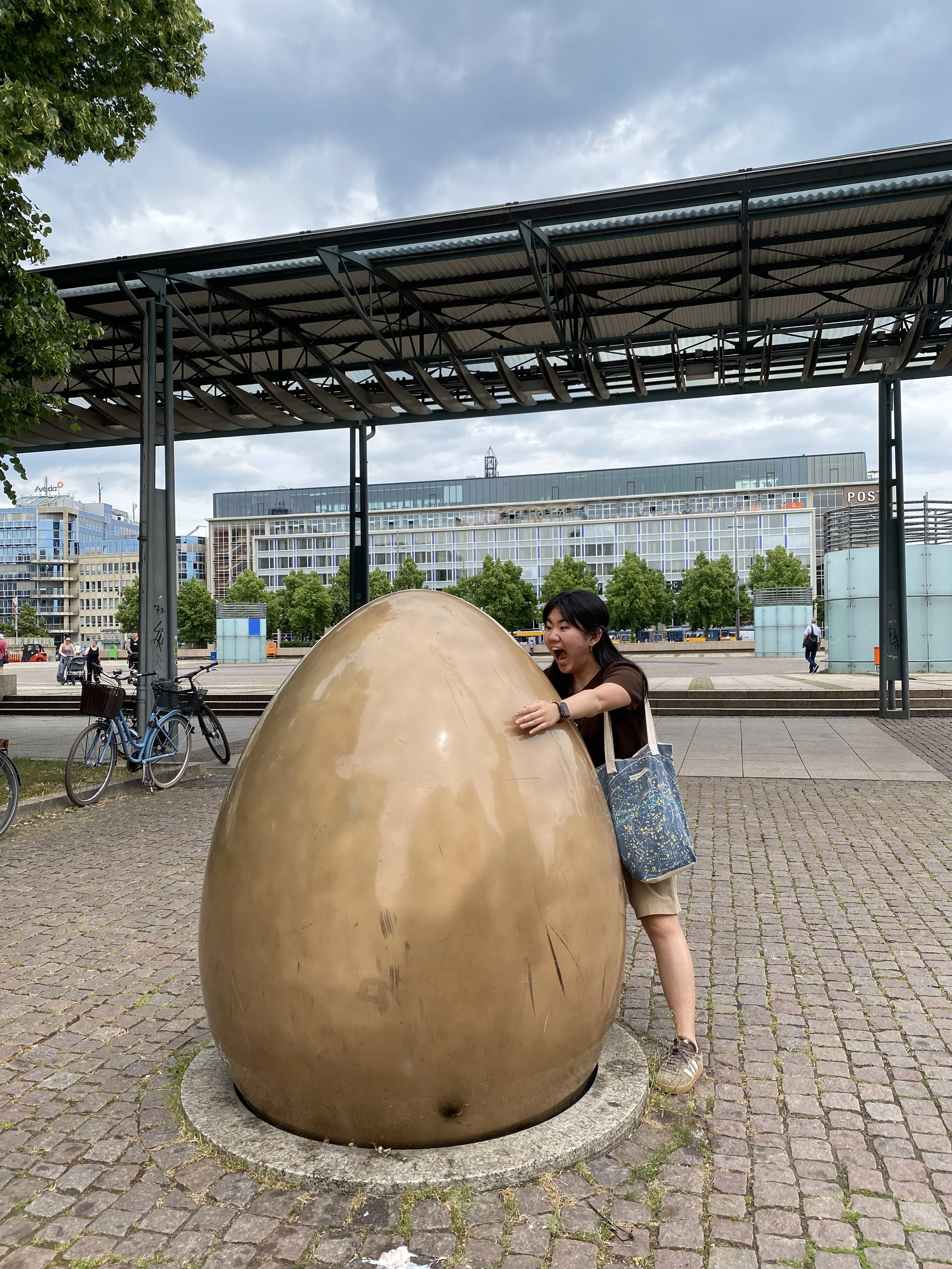
EGG!!
After a moment of fangirling and enthusiastic picture-taking, however, another thought occurred to me: Why is there an egg in the middle of the city?
According to my research, the egg has a name: Demokratieglocke, or The Democracy Bell. Standing only 10cm shorter than me at 150cm, it commemorates the Friedliche Revolution (“Peaceful Revolution”), a series of political protests in 1989 against the communist regime in East Germany, the GDR. These demonstrations ultimately contributed to the fall of the Berlin Wall and the reunification of Germany, and Leipzig played a particularly important role in the movement, serving as one of its major gathering places.
The monument, created by German artist Via Lewandowsky, is relatively new, unveiled on October 9, 2009 for the 20th anniversary of the Monday Demonstration of October 9, 1989.
If it’s a “bell,” does it ring?
Yes! It reliably chimes every Monday night at 6:35pm in remembrance of the beginning of the Monday Demonstration. On all other days, however, it sounds at random times for a random number of strikes within each hour between 8am and 8pm. In other words, don’t rely on the Demokratieglocke to tell the time.
When I first saw it, I was too preoccupied to notice words engraved in the granite ring around the egg. Apparently the inscription is a haiku by German lyric poet , essayist and translator Durs Grünbein:
“Demokratie ist – in unendlicher Nähe – längst sichtbar als Kunst”
(“Democracy is – in infinite proximity – long visible as art”)
But what does an egg have to do with democracy?
There seem to be several interpretations. An egg is often a symbol of new life and rebirth. Some point to the idiom sich ein Ei legen (“to lay an egg on oneself”), which colloquially means to create a problem for oneself that will eventually come back to haunt you. Others see the golden egg as a nod to the way many East Germans once viewed the West, as something golden and full of promise.
This blog is a public service announcement in favor of more peculiar artwork and monuments scattered throughout our cities. Not only do they add a sense of wonder to everyday commutes, but they also spark curiosity, which I believe is the best doorway to exploration and learning. Education and the preservation of history need not exist only in books or on Google; they can live in our physical environments as well. In an age of technology and constant stimulation, perhaps we need more reminders to look up, ask questions, and learn something new.
The next time I visit the egg, I will imagine myself standing amidst the Monday Demonstration: 70,000 people around me, candles in their hands and prayers on their lips, gathered peacefully in pursuit of freedom.
Sources:
“Res severa verum gaudium” — True joy is a serious matter.
28 June 2026The mighty Gewandhaus in Agustusplatz, Leipzig-Mitte.
This was the first concert hall I had ever visited that proudly displayed text across its back wall. Even during performances, the inscription remains illuminated, looming over the stage as if constantly reminding the audience of its presence.
“Res severa verum gaudium.”
In Deutche: “Wahre Freude ist eine ernste Sache.”
In Englisch: “True joy is a serious matter.”
Upon my initial google search of the translation at the first Schiff concert, I immediately assumed it was a political statement in support of the arts. Perhaps the ongoing budget cuts to arts and culture were already on my mind.
As it turns out, this is the motto of the Gewandhaus Orchestra, appearing at the top of its mission statement. Directly beneath it, they write:
“Together we bring music to life in order to provide emotional sustenance for our audience. We demand of ourselves the highest possible quality of performance, the conscientious care of our tradition and unwavering commitment to the contemporary. We fulfil this credibly, seriously and enduringly.”
It reads as a promise from musician to listener: that the orchestra approaches its craft with the utmost seriousness and dedication.
The mission statement continues:
“The fostering of tradition and the instigation and cultivation of the new. The active striving for excellence. The creation of values. The nurturing of identity.”
So where do these words originate?
“Res severa verum gaudium” comes from the Stoic philosopher Seneca the Younger in his Epistulae Morales ad Lucilium (Moral Letters to Lucilius), a collection of 124 diary-like letters containing philosophical reflections addressed to Lucilius Junior, the procurator of Sicily during the reign of Nero.
The phrase appears in Letter 23, Section 4: “Verum gaudium res severa est.” The letter is titled On the True Joy Which Comes from Philosophy. Below is the original Latin, followed by the Wikisource translation.
Mihi crede, verum gaudium res severa est. An tu existimas quemquam soluto vultu et, ut isti delicati loquuntur, hilariculo mortem contemnere, paupertati domum aperire, voluptates tenere sub freno, meditari dolorum patientiam? Haec qui apud se versat in magno gaudio est, sed parum blando. In huius gaudii possessione esse te volo: numquam deficiet, cum semel unde petatur inveneris.
“Real joy, believe me, is a stern matter. Can one, do you think, despise death with a care-free countenance, or with a ‘blithe and gay’ expression, as our young dandies are accustomed to say? Or can one thus open his door to poverty, or hold the curb on his pleasures, or contemplate the endurance of pain? He who ponders these things in his heart is indeed full of joy; but it is not a cheerful joy. It is just this joy, however, of which I would have you become the owner; for it will never fail you when once you have found its source.”
In essence, Seneca reminds Lucilius that true happiness is not the same as constant cheerfulness. He challenges the hedonistic impulse to maximize pleasure and minimize pain, arguing instead that genuine joy comes from cultivating the inner strength to face hardship with courage, self-control, and resilience. Once you discover that source of joy within yourself, it cannot be taken away. Wealth or poverty, health or illness, praise or criticism—external circumstances may change, but they no longer determine your inner peace.
It is fascinating to see how words written sometime between AD 62 and 65 have traveled through nearly two millennia, acquiring new contexts and, with them, new layers of meaning. What began as Seneca’s meditation on the pursuit of inner virtue has become the guiding motto of one of the world’s great orchestras on profound artistic joy and the discipline it requires, eventually reaching my attention and sparking new dialogue.
Comment from a classmate, 16 July 2026: Hi Yuri! Considering the fact that this is, as far as I understand, your personal motto as well, I wonder what you think it actually looks like for an an institution to commit to this purpose? More than a personal philosophy, how can joy be practiced at a wider scale, and what does that mean if we consider the origin of the sentiment. . . in the deeply personal, inward looking philosophy of Seneca?
My response, 17 July 2026: Hi Julian! Thank you for your thoughtful comment; I love your questions! I believe that a non-negotiable ingredient of joy is a commitment to sharing it. We deprive joy of its full potential and meaning when we mistake it for a purely private experience. For an institution to truly commit to this purpose, I think it must offer more than serious dedication, artistic excellence, and thoughtful programming. It should actively invite its audience to celebrate being alive and getting to engage in the profound expression and human connection that art makes possible. (I’ve been thinking about this a lot lately—how performers can translate the joy of learning and performing a piece into an equally meaningful and rewarding experience for the listener. I’ve learned that a good starting point is simply embodying the joy of performing; our facial expressions and body language can go a long way toward inviting the audience into that experience.)
My belief may seem at odds with Senca’s intimate, inward-looking philosophy. But without first cultivating inner peace within yourself, it’s difficult to share it with others. And, when I read Seneca alongside Epictetus—“It is quite impossible to unite happiness with a yearning for what we don’t have”—I see a shared call to be fully present and content with the life before us. Marcus Aurelius takes that one step further when he writes that “joy for human beings lies in proper human work,” beginning with “acts of kindness to other human beings” and “contemplating the natural order and all that happens in keeping with it.” Something magical happens with joy at the point where inner revelation meets outward expression of generosity and community.